Susan
GRAMMAR
Grammar essentials
Review the three grammar topics for this chapter: Nationalities, Regular verbs and Question words.
GRAMMAR
3 ESSENTIAL TOPICS
Explore the grammar guide
Use Previous and Next to review the three topics. Open any card at full size to read the details. English explanations follow below.
1 / 3 · Nationalities
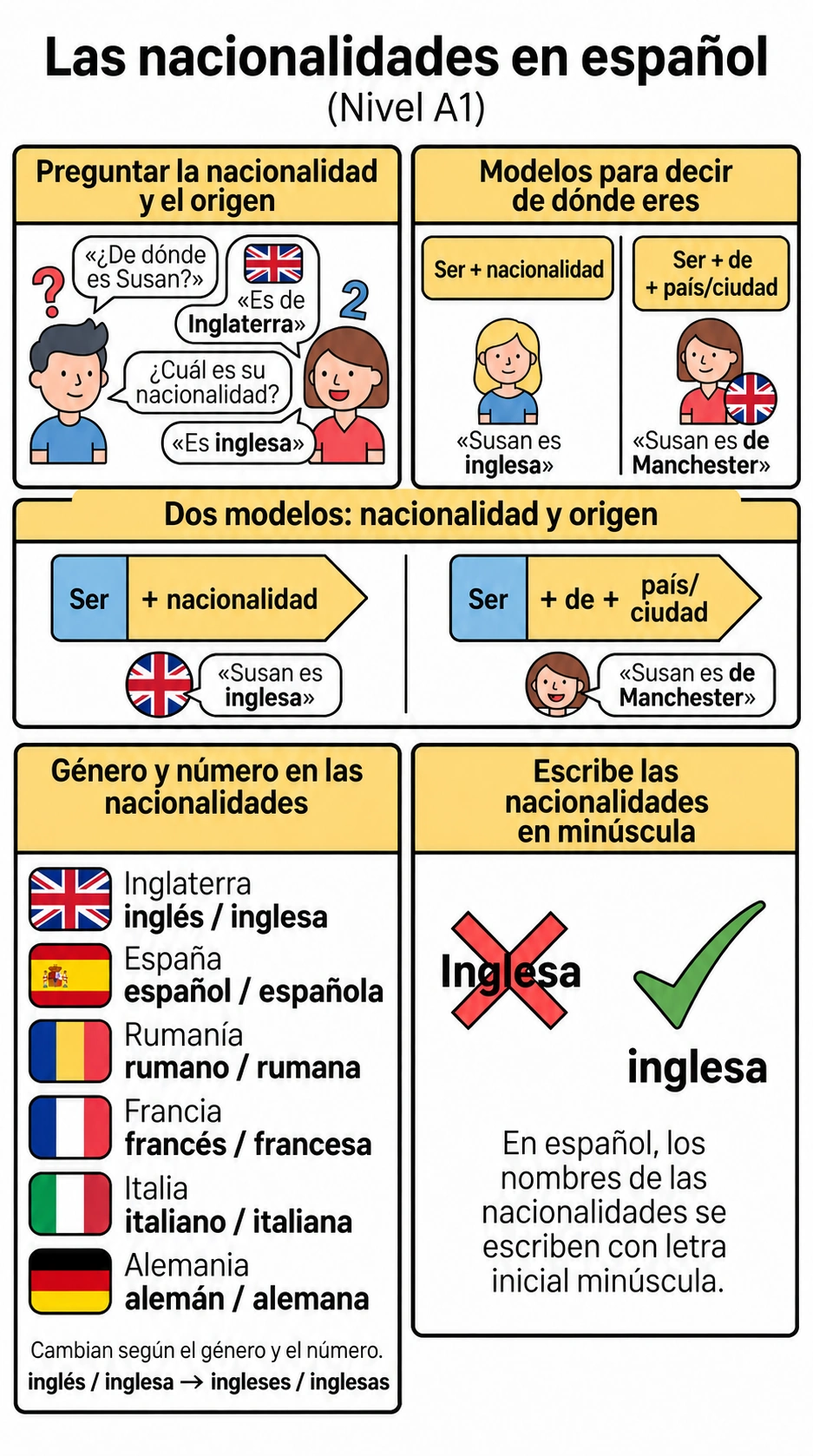
1. Nationalities and origin
Use SER + nationality to say someone’s nationality: “Susan es inglesa” — Susan is English. Use SER + de + country or city to say where someone is from: “Susan es de Manchester”. Her origin and her current home are different: the story says “Vive en Los Dolses” — she lives in Los Dolses.
Nationality adjectives agree with the person or people they describe. Compare inglés / inglesa and ingleses / inglesas. Notice the accent in inglés and its absence in ingleses. Country and city names begin with a capital letter; nationality adjectives normally begin with a lowercase letter: Inglaterra → inglés / inglesa. The other country pairs on the card are additional language examples, not facts about Susan.
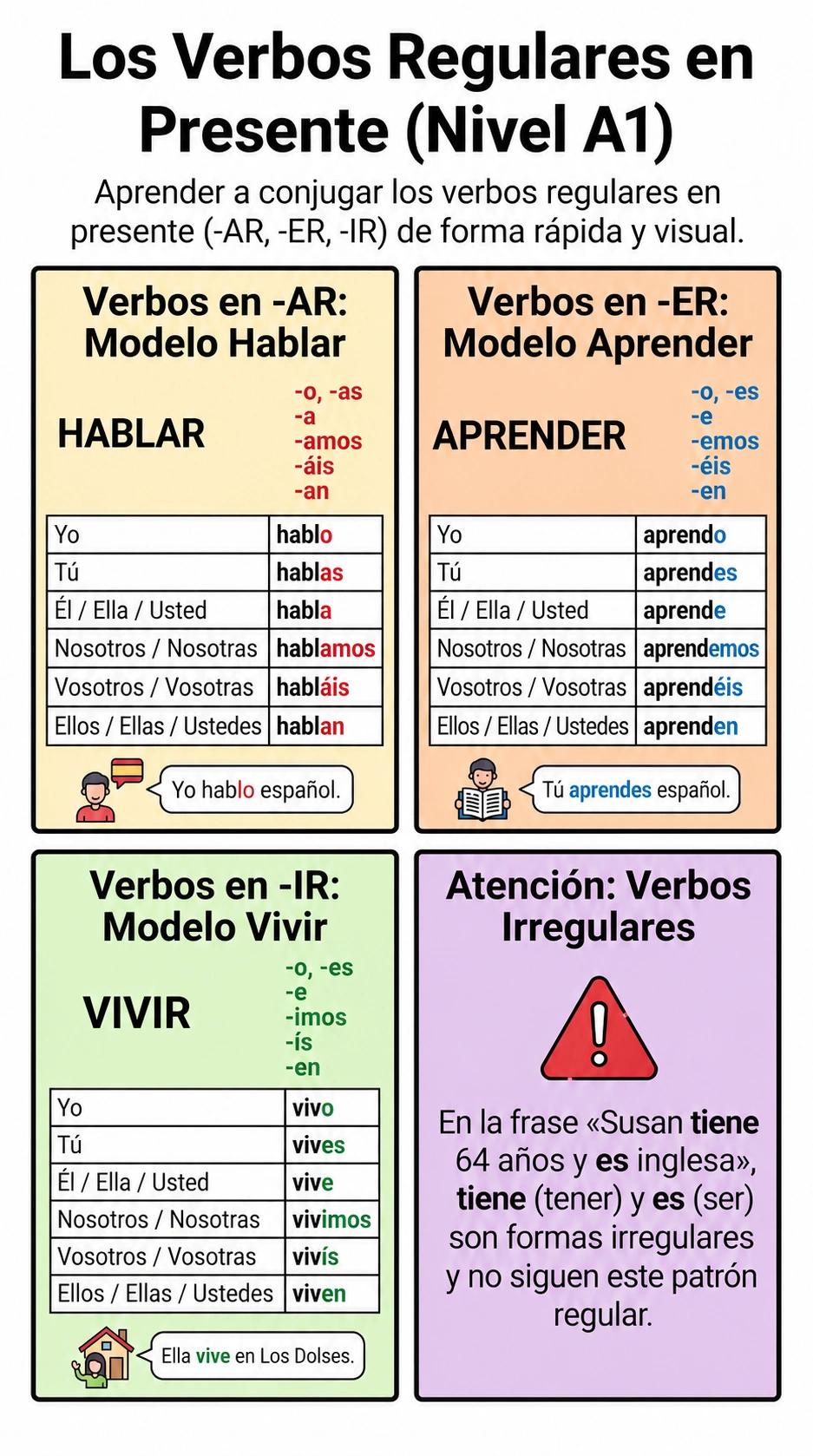
2. Regular verbs in the present tense
The present tense describes current situations and habits. The chapter gives “Susan estudia español los martes y los jueves”, “Antonio habla despacio” and “Vive en Los Dolses”. These mean that Susan studies Spanish on Tuesdays and Thursdays, Antonio speaks slowly, and Susan lives in Los Dolses.
For regular verbs, remove -ar, -er or -ir from the infinitive and add the ending for the subject. The card shows the complete patterns for hablar (to speak), aprender (to learn) and vivir (to live). With yo, all three end in -o; with él / ella / usted, -ar verbs use -a and -er/-ir verbs use -e. Vosotros / vosotras is the informal plural “you” used in Spain.
The card’s “Yo hablo español” and “Tú aprendes español” are practice models, not quotations from the story. In the source sentence “Susan tiene sesenta y cuatro años y es inglesa”, tiene comes from tener and es comes from ser. These are irregular forms; do not apply the regular patterns to them.
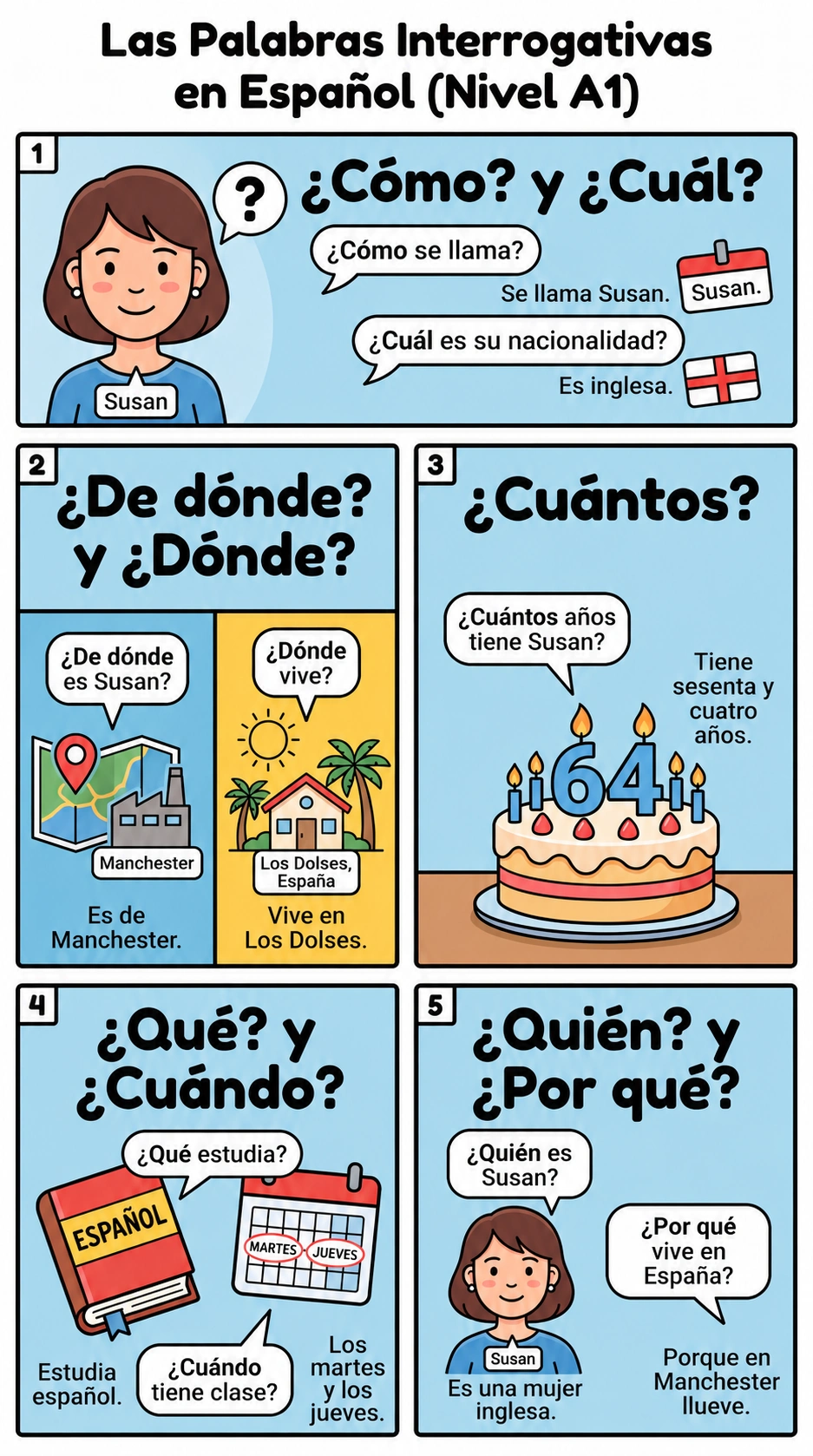
3. Question words
Use qué for “what”, quién for “who”, dónde for “where”, de dónde for “where from”, cuándo for “when”, cómo for “how”, and por qué for “why”. Cuál asks for identification or a choice: “¿Cuál es su nacionalidad?” — “Es inglesa”. To ask someone’s name, Spanish uses “¿Cómo se llama?” — “What is her name?” here.
Compare origin and residence: “¿De dónde es Susan?” — “Es de Manchester”; “¿Dónde vive?” — “Vive en Los Dolses”. For age, use “¿Cuántos años tiene Susan?” — “Tiene sesenta y cuatro años”. Ask about her studies with “¿Qué estudia?” and her class days with “¿Cuándo tiene clase?”.
Question words carry written accents. Spanish questions use both ¿ and ?. Keep por qué (why, in a question) separate from porque (because, in an answer): “¿Por qué vive en España?” — “Porque en Manchester llueve”.
Continue learning
Continue to Build to practise familiar sentences, then apply these patterns in Substitution Drills.